
FDCT Promotes the Internationalization of Traditional Chinese Medicine and the Development of a China–Portugal AI Public Health Technology Platform
24/11/2025
24/11/2025
Plaque Unveiled for the Overseas Base of the Community Smart Chinese Medicine Dispensary Research Project
Mr. Cheng Kuan Wai, Member of the Administrative Committee of the Macao Science and Technology Development Fund (FDCT), visited Lisbon, Portugal from 9 to 15 November to participate in the “Web Summit – Macao Innovation and Technology Enterprises Exchange Mission to Lisbon.” During his visit, he was invited to attend the plaque unveiling ceremony of the “Overseas Base of the Community Smart Chinese Medicine Dispensary Research Project” held on 11 November at the Traditional Chinese Medicine Centre in Portugal. The base is tasked with the important mission of promoting the development and implementation of Traditional Chinese Medicine (TCM) in Portugal. Also present at the event were Ms. Huang Lin and Mr. Qiao Changwei, First Secretaries responsible for science and technology affairs at the Embassy of the People's Republic of China in Portugal. Together, they witnessed the official launch of the “Community Smart Chinese Medicine Dispensary” project in Portugal, a joint R&D initiative between AnSyn Tech (Macau) Co., Ltd. and the Guangdong Provincial Laboratory of Traditional Chinese Medicine, with funding support from the FDCT. Following the ceremony, an online meeting was held with Dr. Han Zitian, Associate Director of the China–Portugal Belt and Road Joint Laboratory on Artificial Intelligence and Public Health Issues (Macau University of Science and Technology), Dr. Chen Wenqian, Chief Physician of the Traditional Chinese Medicine Centre in Lisbon, and Dr. Yang Zifeng, Executive Deputy Director of the China–Portugal Belt and Road Joint Laboratory on Artificial Intelligence and Public Health Issues (Guangzhou Medical University) and Deputy Director of the Guangzhou Institute of Respiratory Health.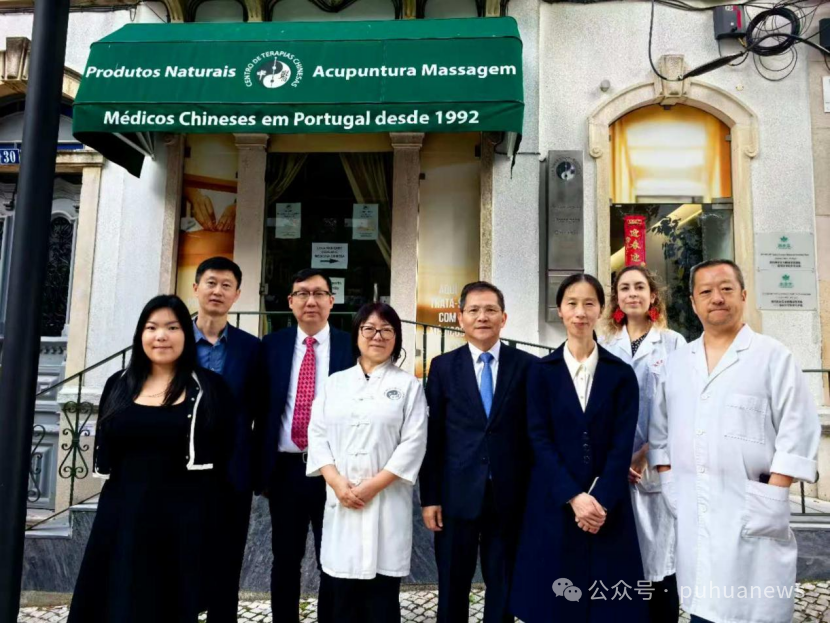
Plaque Unveiled for the “Macao UOCT TCM Overseas Base – Lisbon Liaison Office”
(Photo source: [EuropeWeekly])
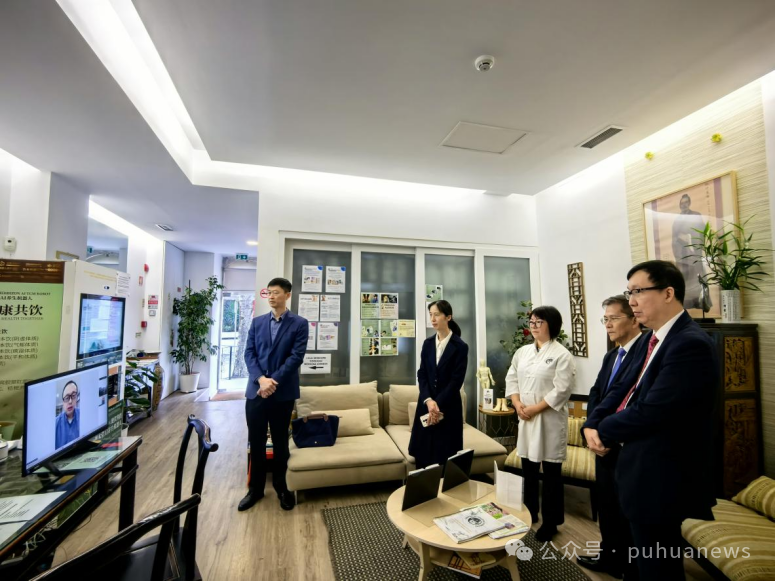
Online Meeting
(Photo source: [EuropeWeekly])
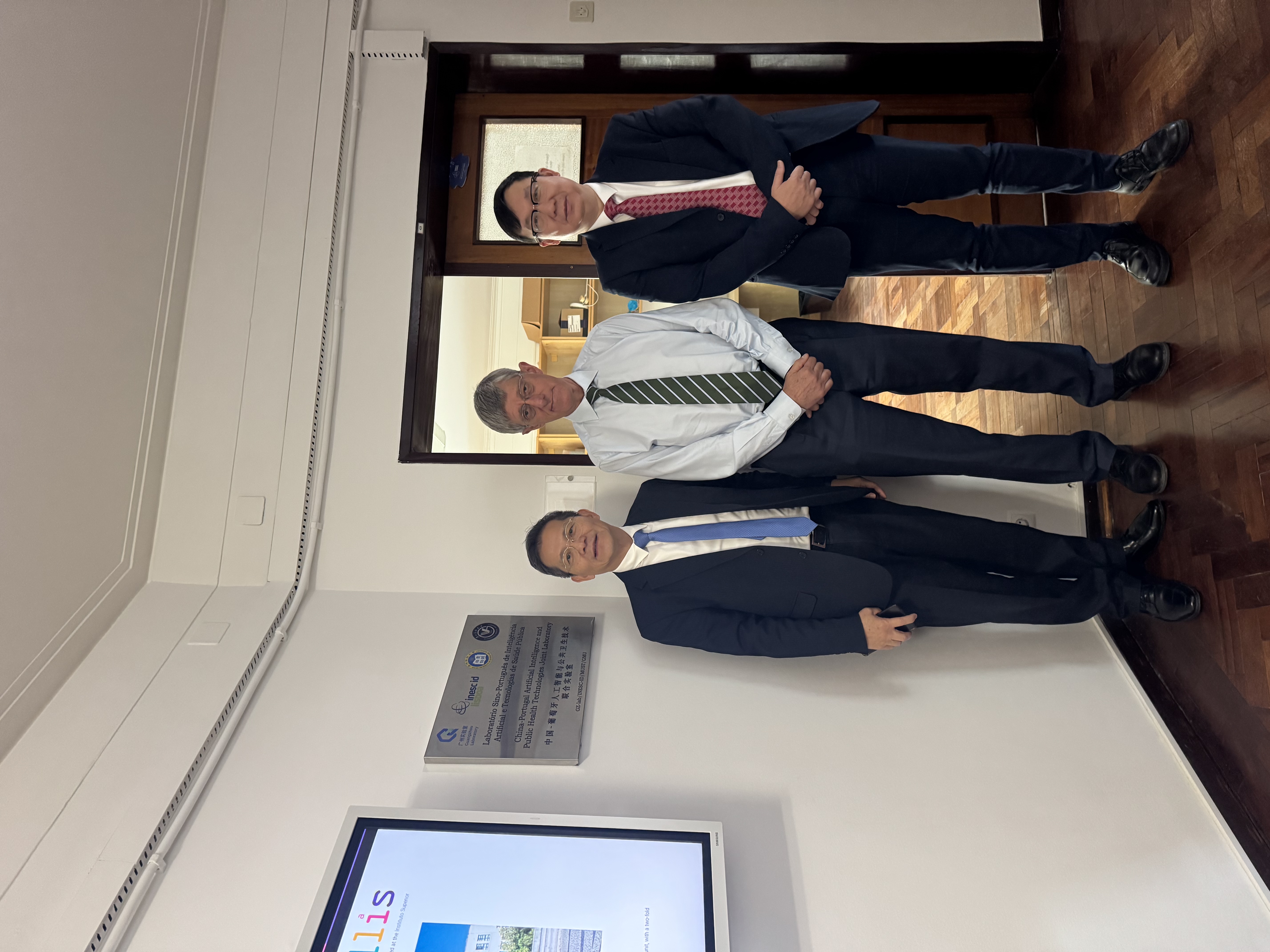
Visit to the China–Portugal “Belt and Road” Joint Laboratory
Mr. Cheng Kuan Wai, Member of the Administrative Committee of the Macao Science and Technology Development Fund (FDCT), visited Lisbon, Portugal from 9 to 15 November to participate in the “Web Summit – Macao Innovation and Technology Enterprises Exchange Mission to Lisbon.” During his visit, he was invited to attend the plaque unveiling ceremony of the “Overseas Base of the Community Smart Chinese Medicine Dispensary Research Project” held on 11 November at the Traditional Chinese Medicine Centre in Portugal. The base is tasked with the important mission of promoting the development and implementation of Traditional Chinese Medicine (TCM) in Portugal. Also present at the event were Ms. Huang Lin and Mr. Qiao Changwei, First Secretaries responsible for science and technology affairs at the Embassy of the People's Republic of China in Portugal. Together, they witnessed the official launch of the “Community Smart Chinese Medicine Dispensary” project in Portugal, a joint R&D initiative between AnSyn Tech (Macau) Co., Ltd. and the Guangdong Provincial Laboratory of Traditional Chinese Medicine, with funding support from the FDCT. Following the ceremony, an online meeting was held with Dr. Han Zitian, Associate Director of the China–Portugal Belt and Road Joint Laboratory on Artificial Intelligence and Public Health Issues (Macau University of Science and Technology), Dr. Chen Wenqian, Chief Physician of the Traditional Chinese Medicine Centre in Lisbon, and Dr. Yang Zifeng, Executive Deputy Director of the China–Portugal Belt and Road Joint Laboratory on Artificial Intelligence and Public Health Issues (Guangzhou Medical University) and Deputy Director of the Guangzhou Institute of Respiratory Health.
Plaque Unveiled for the “Macao UOCT TCM Overseas Base – Lisbon Liaison Office”
(Photo source: [EuropeWeekly])
Online Meeting
(Photo source: [EuropeWeekly])
The project was successfully launched in Lisbon following the signing of a cooperation agreement in March this year between UOCT Health Technology Co., Ltd. (Hengqin Guangdong-Macao In-Depth Cooperation Zone) and the Traditional Chinese Medicine Centre in Portugal. Through this initiative, the “UOCT AI-Powered TCM Robot” was introduced to Lisbon. Integrating a proprietary TCM AI large model with intelligent diagnostic and prescription technology, the robot is capable of completing diagnosis and herbal decoction within minutes, providing convenient TCM services to community residents.
The project leverages Macao’s unique advantage as a “bridge between China and Portuguese-speaking countries”, successfully opening up the Lusophone market and facilitating the entry of various renowned traditional Chinese medicinal formulas into Portugal and the European Union. It exemplifies how technological innovation can accelerate the modernization and internationalization of Traditional Chinese Medicine.
Visit to the China–Portugal Belt and Road Joint Laboratory to Enhance International Collaboration on Epidemic Early Warning
The delegation also visited the China–Portugal Belt and Road Joint Laboratory on Artificial Intelligence and Public Health Issues located in Lisbon, showcasing Macao’s achievements in fostering Sino-Portuguese cooperation and scientific innovation. Professor Arlindo, head of the laboratory, introduced the laboratory’s progress and collaboration with Macao and expressed plans to visit Macao next March for academic exchanges.
The Joint Laboratory is jointly operated by the Macau University of Science and Technology, Guangzhou Medical University, and the Institute for Systems and Computer Engineering – Research and Development in Lisbon (INESC-ID). Its mission is to harness artificial intelligence technologies to enhance public health. The laboratory’s core initiative, the “AI-Based Large-Scale Epidemic Intelligent Forecasting and Early Warning System”, is funded by the Macao Science and Technology Development Fund (FDCT). Developed collaboratively by Professor Han Zitian’s team at the Macau University of Science and Technology and the Guangzhou Institute of Respiratory Health, the system combines big data and AI models to deliver accurate predictions for infectious disease outbreaks. It has already been applied in several provinces and cities in mainland China, earning recognition from governmental departments.
This visit further reinforced the platform’s role as a vital hub for international collaboration under the Belt and Road Initiative. The FDCT will continue supporting these innovative projects, leveraging Macao’s role as a bridge to facilitate Sino-Portuguese cooperation in science and technology and in public health data forecasting and early warning, thereby contributing to the well-being of Portuguese-speaking countries and the global community.
The project leverages Macao’s unique advantage as a “bridge between China and Portuguese-speaking countries”, successfully opening up the Lusophone market and facilitating the entry of various renowned traditional Chinese medicinal formulas into Portugal and the European Union. It exemplifies how technological innovation can accelerate the modernization and internationalization of Traditional Chinese Medicine.
Visit to the China–Portugal Belt and Road Joint Laboratory to Enhance International Collaboration on Epidemic Early Warning
The delegation also visited the China–Portugal Belt and Road Joint Laboratory on Artificial Intelligence and Public Health Issues located in Lisbon, showcasing Macao’s achievements in fostering Sino-Portuguese cooperation and scientific innovation. Professor Arlindo, head of the laboratory, introduced the laboratory’s progress and collaboration with Macao and expressed plans to visit Macao next March for academic exchanges.
The Joint Laboratory is jointly operated by the Macau University of Science and Technology, Guangzhou Medical University, and the Institute for Systems and Computer Engineering – Research and Development in Lisbon (INESC-ID). Its mission is to harness artificial intelligence technologies to enhance public health. The laboratory’s core initiative, the “AI-Based Large-Scale Epidemic Intelligent Forecasting and Early Warning System”, is funded by the Macao Science and Technology Development Fund (FDCT). Developed collaboratively by Professor Han Zitian’s team at the Macau University of Science and Technology and the Guangzhou Institute of Respiratory Health, the system combines big data and AI models to deliver accurate predictions for infectious disease outbreaks. It has already been applied in several provinces and cities in mainland China, earning recognition from governmental departments.
This visit further reinforced the platform’s role as a vital hub for international collaboration under the Belt and Road Initiative. The FDCT will continue supporting these innovative projects, leveraging Macao’s role as a bridge to facilitate Sino-Portuguese cooperation in science and technology and in public health data forecasting and early warning, thereby contributing to the well-being of Portuguese-speaking countries and the global community.
Visit to the China–Portugal “Belt and Road” Joint Laboratory

Office address: Avenida do Infante D. Henrique, No. 43-53A, Macau Square, 8th Floor, Unit C and 11th Floor, Unit K, Macao (To apply for project funding, please go to 11th Floor, Unit K)
Office hours: Monday to Thursday: 9:00-13:00, 14:30-17:45;Friday: 9:00-13:00, 14:30-17:30;Tel.: 28788777
Copyright(C) 2021 ALL right reserved.
Office hours: Monday to Thursday: 9:00-13:00, 14:30-17:45;Friday: 9:00-13:00, 14:30-17:30;Tel.: 28788777
Copyright(C) 2021 ALL right reserved.